
Wildlife & nature
This island lost the dodo and very nearly lost everything else. What survived is a small, strange and genuinely remarkable set of species, most of it brought back from the edge, and almost all of it visible in a single day if you know where to stand.
Mauritius is famous in biology for a bird it killed. The dodo was gone within about a century of Dutch settlement, and it took most of the island’s other endemic species with it or shortly after: a flightless red rail, two giant tortoise species, a giant skink, several parrots.
What makes the wild animals in Mauritius worth a day of your holiday is the other half of the story. Some of the most successful species recovery work anywhere on earth has happened on this island. The Mauritius kestrel was down to four known birds in the wild in the 1970s. The pink pigeon was down to about ten. Both are still here, and you can go and look at them.
This guide covers which wild animals in Mauritius actually live here now, where to stand to see them, and what you will realistically spot on a normal day rather than in a documentary.
Worth understanding before you look for anything, because it explains why the wild animals in Mauritius are where they are, and why they are not anywhere else.
The island had no native land mammals except bats, and no predators. Everything that evolved here evolved without needing to run, hide or fly away. When ships arrived with rats, cats, monkeys, pigs and people, that was catastrophic, and the forest went to sugar cane at the same time. Around two per cent of the original native forest remains.
What that means practically: the surviving endemic species are concentrated in the last fragments of native forest and on a handful of predator free offshore islands. You will not see them from a resort. You have to go to the specific places.
| Species | Status | Best place to see it |
|---|---|---|
| Mauritius kestrel | Endemic, recovered from near extinction | Black River Gorges, Vallee de Ferney |
| Pink pigeon | Endemic, recovered from near extinction | Ile aux Aigrettes, Black River Gorges |
| Echo parakeet | Endemic, recovered | Black River Gorges |
| Mauritius fody | Endemic, very rare | Ile aux Aigrettes |
| Mauritius olive white eye | Endemic, very rare | Ile aux Aigrettes, Black River Gorges |
| Mauritius fruit bat | Endemic, still widespread | Almost anywhere at dusk |
| Ornate day gecko | Endemic | Ile aux Aigrettes, gardens |
| Telfair's skink | Native to the region, reintroduced | Ile aux Aigrettes |
| Aldabra giant tortoise | Introduced as an ecological stand in | Ile aux Aigrettes, La Vanille |
| Dodo | Extinct since the 1600s | Natural History Museum, Port Louis |
Swipe to see the full table
The birds are the reason serious naturalists come looking for wild animals in Mauritius, and the three headline species are the best conservation story in the Indian Ocean.
A small forest falcon that hunts geckos among the trees rather than hovering over open ground like a European kestrel. In the mid 1970s the known wild population was four birds, which made it about the rarest bird on the planet. Captive breeding and nest box work brought it back.
Your best chance is Vallee de Ferney in the south east, where there is a supervised feeding programme, or a patient morning in Black River Gorges.
Genuinely pink, larger than a wood pigeon, and down to roughly ten individuals in the 1990s. The population now runs into the hundreds across several managed sub populations. It is the easiest of the three to actually see, because the birds on Ile aux Aigrettes are used to people and will feed a few metres away.
The only surviving native parrot of the Mascarene islands, and the hardest of the three to see. Green, noisy and fast through the canopy. Listen rather than look: the call is distinctive and usually the first sign.
Honestly, introduced birds. Red whiskered bulbuls, common mynas, village weavers, zebra doves and red fodies are everywhere including hotel gardens, and the bright red male fody in particular gets photographed constantly and mistaken for something rare. They are lovely and they are not endemic.
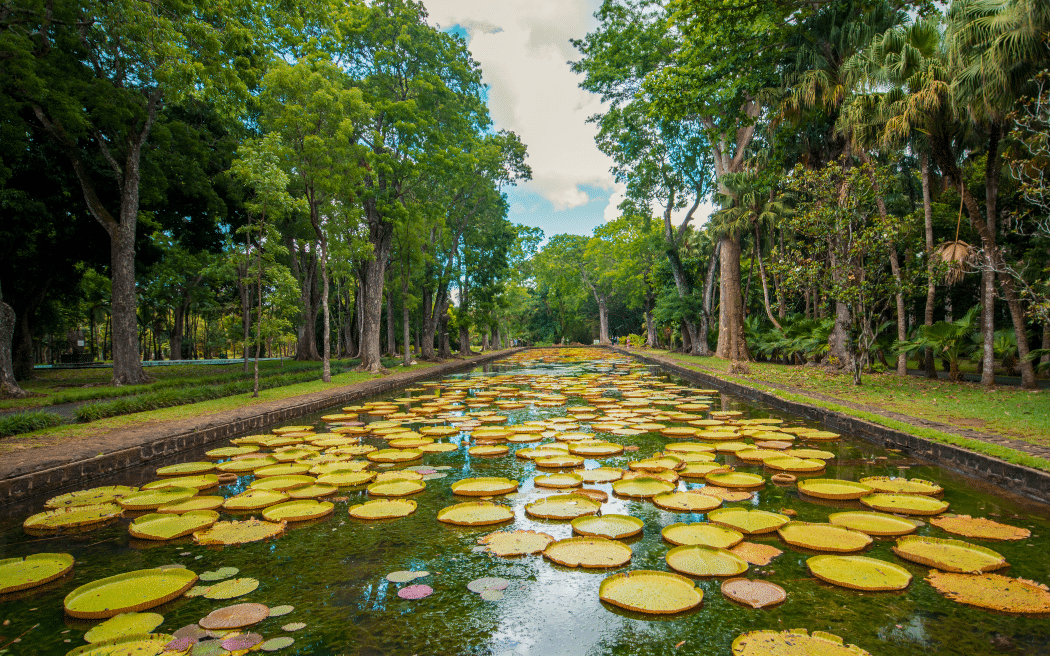
The reptiles are the most visible of the wild animals in Mauritius, and the most confusing, because the biggest ones are not from here.
Aldabra giant tortoises. These come from Aldabra in the Seychelles. Mauritius had two endemic giant tortoise species and both were eaten to extinction by the eighteenth century. The Aldabras were introduced deliberately, as ecological replacements: giant tortoises graze and disperse seeds in a way nothing else on the island does, and native plants had evolved to depend on that. It is one of the more interesting conservation experiments anywhere, and it appears to be working.
See them at Ile aux Aigrettes in a restored wild setting, or in far larger numbers at La Vanille Nature Park in the south.
Day geckos. Bright green, often with red markings, active in daylight and completely unafraid. Several endemic species. You will very likely see one on a wall or a palm without looking for it.
Telfair’s skink. A large, glossy, confident lizard reintroduced to Ile aux Aigrettes after being wiped out on the mainland by rats and mongooses. They walk up to visitors.
Snakes. There are no dangerous snakes in Mauritius. Two endemic boas survive only on Round Island, which is closed to visitors. You will not meet a snake here.
The list of wild animals in Mauritius gets short here. The island never had native land mammals apart from bats.
The Mauritius fruit bat, or flying fox, is the island’s only surviving endemic mammal and by some distance the most impressive thing in the sky here. A wingspan approaching a metre, a fox like face, and entirely harmless. They roost in large trees and stream out at dusk in numbers you can count from a hotel balcony. They are also controversial: they eat fruit, growers lose crops, and the species has been subject to culls, which conservation bodies have opposed.
Long tailed macaques are introduced, numerous, and visible along the Black River Gorges road and around Grand Bassin. Do not feed them and do not leave a bag open. They are quick and they are not shy.
Java deer, introduced by the Dutch, live in private hunting estates and forests across the south. You may see one crossing a road at dusk.
Mongooses, rats, shrews, feral cats and wild boar are all introduced, and between them are the reason so much of the original fauna is gone.
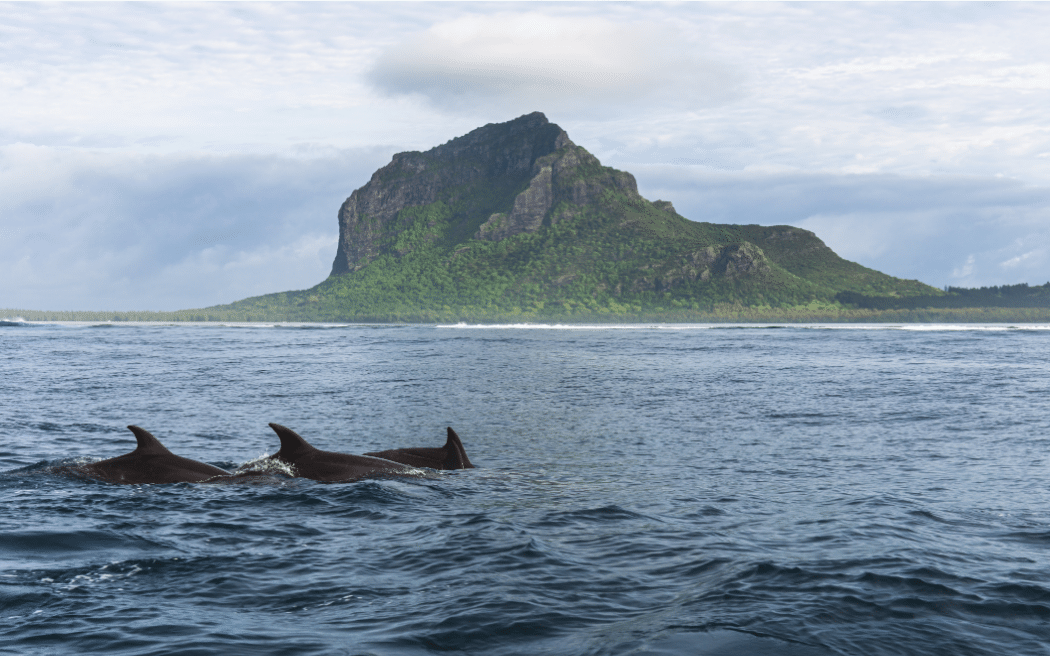
The most reliable of the wild animals in Mauritius are not on land at all.
| Animal | Season | Where | How you see it |
|---|---|---|---|
| Spinner dolphins | All year | West coast off Tamarin | Early morning boat trip |
| Bottlenose dolphins | All year | West coast | Same boat trips |
| Humpback whales | July to October | West and south coasts | Dedicated boat trip |
| Sperm whales | All year, less predictable | Deep water off the west | Specialist operators |
| Green turtles | All year | Ile aux Benitiers, Le Morne, Coin de Mire | Snorkelling |
| Eagle rays and stingrays | All year | East and south east lagoon | Snorkelling |
| Reef fish | All year | Every lagoon | Snorkelling from the beach |
Swipe to see the full table
The dolphins off Tamarin are resident rather than migratory, which is why the trips run every day and why they leave at six in the morning: the pods rest inshore early and move out as the day warms and the boats arrive. Go on the first departure or do not bother.
Swimming with dolphins is regulated here, and the rules exist because the pods were being harassed. A good operator keeps its distance and its engine off. Our snorkeling guide covers where the turtles are.
Five places account for almost every one of the wild animals in Mauritius worth travelling to see. Drive times are from the airport.
| Place | What you see | From airport | Booking | Entry |
|---|---|---|---|---|
| Black River Gorges National Park | Kestrel, echo parakeet, macaques, native forest | 45 min | None needed | Free |
| Ile aux Aigrettes | Pink pigeon, fody, skinks, giant tortoises, ebony forest | 15 min | Book ahead, guided only | Paid |
| Vallee de Ferney | Mauritius kestrel feeding, native forest walk | 25 min | Book ahead | Paid |
| La Vanille Nature Park | Giant tortoises in numbers, crocodiles, insects | 30 min | None needed | Paid |
| Tamarin and the west coast | Spinner dolphins, humpback whales in season | 55 min | Book the boat ahead | Paid |
Swipe to see the full table
Ile aux Aigrettes is the one to prioritise if you only do one. It is a small coral island off the south east coast, cleared of rats and restored to the ebony forest that once covered the coastal lowlands, and it holds more endemic species per hectare than anywhere else in the country. Visits are guided only and must be booked, which is exactly why it works.
Black River Gorges National Park costs nothing to enter and holds more wild animals in Mauritius than any paid attraction on the island. The Gorges Viewpoint needs no walking at all. If you want to walk, the Macchabee Trail takes about three hours return and is where the echo parakeets are.
Expectation setting, because pages about wild animals in Mauritius tend to promise more than the morning delivers.
Time of day matters more than time of year for the birds. Be in the forest by seven. By ten in the morning the endemic birds are quiet and you are looking at bulbuls.
May to October is the better season for walking: dry trails, low humidity, clear views. The forest is easier and the birds are no harder.
July to October is humpback whale season off the west and south coasts.
What a normal day gives you. On Ile aux Aigrettes with a guide, you will almost certainly see pink pigeons, giant tortoises, Telfair’s skinks and day geckos. In Black River Gorges you will very likely see macaques and hear parakeets, and you may or may not see a kestrel. On a dawn boat off Tamarin you will very probably see dolphins. Anyone promising you better odds than that is selling something.
You cannot write about wild animals in Mauritius without the bird that is not here. It is worth a section because the response to losing it is the reason anything else survived.
The dodo was a large flightless pigeon, endemic to this island and nowhere else, and it was gone within roughly a century of Dutch settlement in the 1600s. Hunting played a part. The rats, pigs, monkeys and cats that came off the ships and ate eggs and chicks played a larger one. It is the textbook example of what happens to an island fauna that evolved without predators.
There is no complete stuffed dodo anywhere in the world. The Natural History Museum in Port Louis holds a reconstructed skeleton assembled from bones found at Mare aux Songes, a marsh in the south east, and it is free to visit and takes twenty minutes.
What matters for the surviving wild animals in Mauritius is what came next. From the 1970s onwards a small group of biologists took on species that were, by any reasonable assessment, already lost: a falcon down to four birds, a pigeon down to about ten. Captive breeding, nest boxes, predator control and island restoration brought both back. The same methods have since been exported to recovery programmes worldwide.
So the honest framing of wildlife here is not a rich ecosystem you have come to admire. It is a small, damaged one that was rescued, and every endemic bird you see is the direct result of somebody deciding it was not too late.
This matters more here than in most places. The populations of wild animals in Mauritius are small enough that individual animals count.
Do not feed anything. Especially the macaques, who have learned that tourists mean food and now take it. Feeding is how a wild animal becomes a problem animal and then a dead one.
Keep your distance from dolphins. Do not swim into a resting pod, do not chase, and choose an operator that cuts the engine and keeps back. If a boat drives into the middle of a pod, that is the wrong boat.
Never touch a turtle. Watch, do not follow, and give it room to surface.
Do not take anything off Ile aux Aigrettes, or onto it. The island is rat free and the biosecurity is the entire reason it works.
Stay on the trails in Black River Gorges. The forest fragments are small and the ground flora is part of what is being protected.
The Mauritian Wildlife Foundation runs Ile aux Aigrettes and much of the species recovery work here. Their guided visits fund it directly, which makes that ticket the most useful thing most visitors can do for the wild animals in Mauritius.
The wild animals in Mauritius that are endemic survivors are the Mauritius kestrel, pink pigeon, echo parakeet, Mauritius fody, olive white eye, several day geckos and the Mauritius fruit bat. Aldabra giant tortoises were introduced as ecological replacements. Introduced mammals include macaques, deer, mongooses and wild boar.
No. None of the wild animals in Mauritius on land are dangerous: no venomous snakes, no large predators, no dangerous mammals. The only genuinely hazardous animals are in the sea: stonefish on rocky bottoms and, very rarely, sea urchins. Reef shoes solve both.
Ile aux Aigrettes, off the south east coast, is the reliable place. Visits are guided and must be booked ahead, and the birds there are accustomed to people. They also live in Black River Gorges but are much harder to find.
No. Mauritius had two endemic giant tortoise species and both were driven extinct by the eighteenth century. The Aldabra giant tortoises here today were introduced from the Seychelles as ecological replacements, to graze and disperse seeds the way the native ones did.
Yes, and it is the most reliable wildlife sighting on the island. Spinner and bottlenose dolphins are resident off the west coast near Tamarin all year. Go on the first departure at dawn, when the pods are resting inshore.
Humpback whales pass the west and south coasts from July to October on their migration. Sperm whales are present in deeper water year round but sightings are far less predictable and need a specialist operator.
Yes. It is free, and it holds more wild animals in Mauritius than any paid attraction. It has the last native forest and the largest populations of the endemic birds. The Gorges Viewpoint needs no walking; the Macchabee Trail takes about three hours return and gives you the best chance of echo parakeets.
It was extinct within about a century of Dutch settlement in the 1600s, killed by hunting and by the rats, pigs and monkeys that arrived with ships. There is no live dodo anywhere. The Natural History Museum in Port Louis holds a reconstructed skeleton.
Ile aux Aigrettes, Black River Gorges and Vallee de Ferney sit within about forty minutes of each other in the south, and none of them is realistically reachable by bus. A private day tour gets you to the forest at seven, when the birds are still awake.
See private day toursAbout these figures
Species status, conservation history and the recovery figures for the Mauritius kestrel and pink pigeon come from the Mauritian Wildlife Foundation, which manages Ile aux Aigrettes and much of the species recovery work on the island. Drive times are our own, measured on these routes in normal traffic. Sighting likelihoods reflect what guests actually report rather than what is theoretically possible: these are wild animals and none of it is guaranteed. Opening hours and booking requirements change, so confirm with each site before you travel.
SWIM WITH WILD DOLPHINS IN MAURITIUS
Join a private morning tour to Tamarin Bay — the best spot to encounter spinner dolphins in their natural habitat. Hotel pickup included.
Book the Dolphin Swim Tour →